
A regional grocery chain I know of spent three years watching their customer satisfaction scores plateau despite consistent investment in store improvements — new layouts, better lighting, expanded produce sections, more checkout lanes. The scores weren’t bad. They just weren’t moving. When they finally commissioned a genuine customer friction analysis rather than another store experience survey, the findings pointed somewhere they hadn’t looked: the shopping trip before the shopping trip.
Customers weren’t frustrated by the store. They were frustrated by the preparation that preceded it — checking what was on sale, building a list that matched what was actually in stock, figuring out whether a specific item was available at their preferred location before driving there. All of this happened through a combination of a paper weekly ad, a website that was slow on mobile and didn’t show real-time inventory, and personal memory of what they already had at home. None of it was good. All of it was invisible to the store experience surveys that were measuring satisfaction with the physical visit.
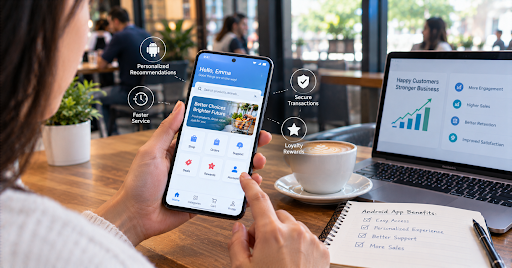
They built an Android-first shopping app — Android-first because their customer demographic analysis showed Android was the dominant platform in their primary market, and their existing website traffic confirmed it. A capable Android App development company with retail experience helped them prioritize features around the pre-trip problem rather than the in-store experience the surveys had been measuring. Twelve months later, customer satisfaction scores had moved more than they had in the previous three years combined. The stores hadn’t changed. The experience of being their customer had.
Why Android Specifically for Customer Experience
The choice of Android as the platform for customer-facing experience investment isn’t always the obvious default — iOS tends to attract more attention in product conversations, particularly in consumer-tech circles where iPhone users are disproportionately represented. But for businesses serving broad consumer markets, the platform choice follows from who the customers actually are, not from which platform feels more prestigious.
Android holds roughly 71 percent of global smartphone market share. In specific demographic and geographic segments — middle-income consumers, customers in markets outside North America and Western Europe, users in rural and suburban areas, and customers in many healthcare and service industry contexts — Android’s share is considerably higher. A regional grocery chain serving middle-income households in a mid-sized city is almost certainly serving a customer base that’s majority Android, and building their primary customer experience app for iOS first means building for a minority of their customers and asking everyone else to wait.
The Android advantage for broad consumer customer experience isn’t only about market share. Android’s more open ecosystem allows customer experience apps to integrate more deeply with the device experience — default app integrations, widget functionality that surfaces information on the home screen without requiring an app open, deeper notification customization — in ways that create more constant, lower-friction touchpoints between a business and its customers. The grocery customer who can see their shopping list progress in a home screen widget without opening the app is experiencing a level of integration with their daily phone use that the store’s brand occupies.
The Pre-Transaction Experience Where Most Friction Lives
The grocery chain’s insight — that customer frustration was concentrated before the store visit rather than in it — is a pattern that applies across many customer experience categories. The friction that determines whether a customer chooses to transact with a business often happens before the transaction, and mobile apps are the most effective tool available for addressing it.
In healthcare, the pre-appointment experience — finding the right provider, understanding what insurance covers, knowing what to bring, understanding what to expect — is consistently where patient frustration peaks, and it’s also the friction that most influences whether a patient follows through on a scheduled appointment or finds a reason to cancel. Android patient experience apps that address these pre-appointment questions — not the clinical care itself but the logistics and information experience around accessing it — have produced measurable improvements in appointment completion rates that the clinical care improvements they were intended to support couldn’t achieve alone.
In home services, the pre-service experience — knowing when the technician will arrive, whether they’ve been to the property before, what the job will likely involve — is where the customer experience anxiety concentrates. The homeowner who booked an HVAC service appointment two weeks ago and now has no information about whether the technician is running on time or late, and no way to reach the specific person coming to their home without calling a general line, is having a pre-service experience that the competent service that eventually arrives can’t fully recover. Android apps that provide real-time technician tracking, service window updates, and technician profiles — knowing that Marcus with four years of experience is forty minutes away — address a customer experience problem that most home service businesses have accepted as unavoidable rather than as something technology can solve.
In retail banking, the customer experience gap that’s produced the strongest response from customers isn’t the in-branch experience, which has been declining in relevance as transaction frequency drops. It’s the experience of accessing account information, understanding transactions, disputing charges, and managing account settings through mobile — the interactions that happen dozens of times a month rather than twice a year. Android banking apps that make these interactions genuinely fast, genuinely clear, and genuinely self-serviceable without requiring a branch visit or a phone call have produced customer satisfaction improvements that branch experience investments couldn’t match.
Personalization That Changes How Customers Experience a Brand
The grocery chain’s app included a feature that the product team debated whether to prioritize: personalized promotions based on purchase history. The debate was about data infrastructure and engineering cost versus the risk that personalization felt intrusive. They built it. The response from customers was uniformly positive — not because the discounts were meaningful but because customers felt recognized.
That recognition — the experience of being seen as a specific person rather than a generic customer — is what personalization at its best produces, and Android apps are the most practical vehicle for delivering it at scale because they’re present in the customer’s daily life in a way that no other channel is.
Personalization in customer experience apps goes through several meaningful levels, each adding value but each also adding complexity to build. At the simplest level, personalization is memory — the app remembers what a customer has done before and surfaces it without requiring them to start from scratch on every interaction. The bank app that defaults to the accounts the customer actually uses rather than displaying all accounts equally. The restaurant app that suggests reordering from a previous visit. The shopping app that organizes the list based on the layout of the specific store location a customer typically visits.
At a more sophisticated level, personalization is prediction — the app surfaces what a customer is likely to want next based on patterns in their behavior. The grocery app that adds an item to a shopping list suggestion because the customer buys it every two weeks and it’s been two weeks. The pharmacy app that reminds a customer about a prescription refill before they notice they’re running low. The fitness app that adjusts a workout recommendation based on how the customer has been sleeping. These predictive personalizations require more data and more inference logic, but they produce customer experiences that feel like genuine attention rather than algorithmic convenience.
Service Recovery and the Customer Retention Moment
One of the highest-value customer experience investments in Android apps is one that receives less attention than the positive experience features: the tools that make service recovery fast enough to retain customers who’ve experienced a problem.
The customer who has a problem with a product, a delivery, a service, or an order has a retention probability that varies enormously based on how quickly and how easily that problem gets resolved. A customer who experiences a problem and can resolve it in three minutes through an app — without holding on a phone call, without navigating a chat bot that doesn’t understand their issue, without waiting for an email response — has a different relationship with the brand than one who spent forty-five minutes getting the same resolution. The app-mediated resolution is better than the phone resolution not because it’s less personal but because it’s faster and available at any hour.
Building service recovery tools into customer experience apps requires accepting that service failures will happen — which is a cultural challenge for businesses that prefer to design for the happy path — and investing in the infrastructure that makes recovery exceptional rather than adequate. Photo upload for defective product returns. One-tap redelivery for delivery failures. Real-time order status with proactive exception alerts rather than reactive responses to customer inquiries. These tools are the difference between service recovery that retains customers and service recovery that confirms their decision to find an alternative.
The Testing Environment That Determines Quality at Scale
One of the most consequential and least glamorous dimensions of Android customer experience app development is the testing infrastructure required to ensure that the experience customers actually receive matches the experience that was designed.
Android’s diversity of devices, screen sizes, operating system versions, and manufacturer customizations means that an app that performs perfectly in the development environment may behave significantly differently for customers using devices the development team didn’t test on. The customer experience implications are direct: a layout that breaks on a specific screen size produces a bad customer experience for every customer using that screen size. A feature that doesn’t work correctly on a specific Android version produces a bad experience for every customer running that version. These aren’t edge cases — Android’s installed base includes a wide range of devices and OS versions that any broadly deployed customer experience app will encounter.
The testing tools and approaches for managing this are worth understanding even for businesses that don’t manage their own development, because they affect the reliability of the customer experience you deploy. Best Android Emulators virtual devices that simulate specific hardware and software configurations — allow development teams to test app behavior across device profiles that would be prohibitively expensive to maintain as physical hardware. Combined with physical device testing on the most common actual devices in a target market and automated testing that catches regressions before they reach production, emulator-based testing reduces the probability that customers encounter behavior that the development team never saw. The grocery chain’s app tested on sixty-three device profiles before launch. The number sounds excessive. It’s the reason the app worked correctly across the full range of customers who downloaded it on launch day.
Loyalty That Compounds Over Time
The customer experience investments that produce the strongest long-term business value aren’t the ones that improve the single transaction — they’re the ones that improve the customer relationship over time, compounding with each interaction into loyalty that’s qualitatively different from the customer who simply hasn’t found a reason to leave yet.
Android apps create loyalty compounding opportunities that other channels don’t, primarily because they’re present in the customer’s daily life in a way that creates regular low-friction touchpoints. The shopping list that a customer maintains in a grocery app creates a habitual return that has nothing to do with promotions or loyalty points — the app is simply where they manage their shopping, and the store is where they buy what the app helped them plan. The fitness studio app where a member books every class becomes the primary interaction medium with that studio, and the studio’s ability to maintain the relationship through the app means the relationship isn’t solely dependent on the in-person visit.
The businesses that have built the deepest customer loyalty through Android apps have done it by consistently adding value between transactions rather than only at them. The notification that surfaces a personalized recommendation before a customer was thinking about making a purchase. The post-transaction follow-up that creates a touchpoint after the sale rather than only before it. The accumulated behavioral data that allows the app to know the customer better with each interaction, making each subsequent interaction slightly more relevant than the last.
What the Grocery Chain Learned
The pre-trip problem they solved was real and the solution worked. But the insight that lasted beyond the launch was this: the customer experience surveys they’d been running for three years were measuring the experience of customers who had already arrived. They had no way to see the customers who hadn’t arrived because the pre-trip friction had sent them somewhere else.
The app didn’t just improve the experience for existing customers. It made the customers who had been going elsewhere findable — customers who, it turned out, were happy to choose the grocery chain when the pre-trip problem was solved. The customer experience investment produced customer acquisition alongside the customer satisfaction improvement, which was an outcome nobody had modeled for because nobody had been measuring the right thing before.
That expansion of what customer experience means — not just the experience of customers who’ve already chosen you, but the experience that determines who chooses you and who doesn’t — is the frame that the most effective Android customer experience apps are built within. Not just making the existing experience better. Making the right experience available to the right customers at the moment they’re deciding.
The grocery chain’s Android app is still their primary customer investment three years after launch. The scores are still moving.